

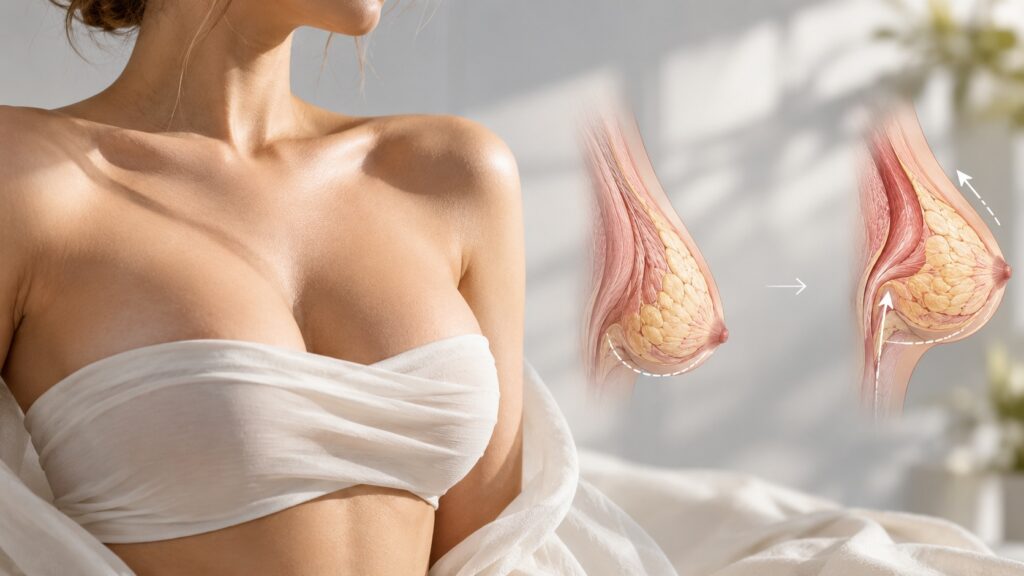
Not everyone considering a breast lift wants larger breasts. For many patients, the concern is more specific: the volume is already there, but it no longer sits where they would like it to. They may want a higher breast position, better projection or more fullness in the upper breast without introducing a silicone implant.
That leads to a practical question: if no implant is added, where does the volume come from? In autoprosthesis and autoaugmentation procedures, the answer can be the patient’s existing breast tissue. Instead of simply removing or reducing this tissue, the surgeon can reposition selected portions of it and use them as part of the new breast structure.
What Does Implant-Free Breast Aesthetics Actually Mean?
Implant-free breast aesthetics covers surgical approaches that lift, reshape or support the breast without inserting a silicone breast implant or another volume-producing implant. Where the anatomy allows, existing breast tissue is preserved and redistributed to help create the desired contour.
This is easier to understand once breast lifting and breast enlargement are separated. Mastopexy primarily addresses breast ptosis, commonly called sagging. Augmentation, on the other hand, adds volume. Some patients fall somewhere between those two goals: they do not necessarily want more breast volume, but they would like their existing volume to sit higher or appear better distributed.
For that group, tissue-preserving autoaugmentation techniques can become relevant.
What Is Autoprosthesis?
Autoprosthesis is the use of a patient’s own breast tissue as an internal source of volume and support. Selected tissue is reshaped and repositioned so that it can contribute to breast projection, contour or upper-pole fullness without relying on a manufactured implant.
The idea has a history in surgical literature. Different autoprosthesis techniques have been described over the years, particularly in connection with mastopexy and the rearrangement of dermoglandular tissue. A 2017 publication, for instance, reported an autoprosthesis mastopexy technique using an inferiorly based parenchymal flap in 184 patients.
There is no single operation represented by the word “autoprosthesis.” Techniques differ in how tissue is prepared, where it is moved and how the surgeon creates internal support.
How Can Existing Breast Tissue Be Used?
A breast with ptosis may still contain enough natural tissue to provide useful volume. In certain autoaugmentation techniques, some of the tissue in the lower part of the breast can be preserved and repositioned rather than treated simply as tissue that needs to be removed.
In simple terms, the surgeon is redistributing existing volume rather than adding new volume. The actual operation is naturally more complex. Tissue quality, blood supply, fixation, individual anatomy and surgical planning all influence what can safely and realistically be done.
Why Is Upper-Pole Fullness Important?
The upper pole is the part of the breast above the nipple. Its fullness can change with age, pregnancy, breastfeeding, weight fluctuations and loss of skin elasticity.
A breast lift can raise the nipple and reshape a sagging breast, but lifting alone does not automatically mean that every patient will achieve the upper-breast fullness she has in mind. Traditionally, an implant may be considered when extra upper-pole volume is wanted. Autoprosthesis approaches take another route by asking whether available natural tissue can be repositioned to contribute to that area instead.
How Is Autoprosthesis Different From a Standard Breast Lift?
In a conventional mastopexy, excess skin is removed and breast tissue is reshaped to create a higher, more balanced contour. With an autoprosthesis approach, selected breast tissue also has a deliberate structural purpose: it is used as internal volume or support.
The distinction sounds small on paper, but surgically it matters. Autoprosthesis is not one standardised operation performed in exactly the same way by every surgeon. Medical literature describes several methods of parenchymal rearrangement and autologous tissue flaps intended to influence projection, support or upper-pole contour.
So the useful question is not simply, “Is this an autoprosthesis?” It is also worth understanding where the tissue is moved, how it is supported and what that particular technique is intended to achieve.
What Is the Dual-Plane Autoprosthesis Approach?
Dual-Plane Autoprosthesis is a more recent variation described by Umut Zereyak and Onur Aksoy in Aesthetic Plastic Surgery in 2026. The technique uses a dermoglandular flap derived from the inferior pedicle and positions it beneath the pectoralis major muscle. The aim is to use the patient’s own tissue to contribute to breast contour, internal support and upper-pole fullness.
This differs from simply folding glandular tissue within the breast. In the described technique, part of the patient’s own tissue is moved into a subpectoral plane, where it functions as an internal source of volume in a different anatomical position.
Readers who want to examine the own-tissue principle in more detail can find patient- and physician-oriented information at pureown, where the relationship between lower-pole tissue, internal support and upper-pole volume is explained in the context of this technique.
Why Does the “Dual-Plane” Part Matter?
The name reflects the anatomical planes involved in the operation. In the published method, an inferior dermoglandular pedicle is mobilised while its vascularity is preserved, then positioned in the subpectoral space. The remaining breast tissue is reshaped as part of the mastopexy.
The intention is to combine autologous upper-pole volume with internal structural support. That anatomical approach is one of the features separating Dual-Plane Autoprosthesis from earlier autoprosthesis methods based mainly on rearranging glandular tissue within the breast itself.
Who May Consider an Implant-Free Breast Lift?
There is no universal patient profile that automatically makes someone suitable. Anatomy has to support the plan. In general, own-tissue autoaugmentation is more relevant when a patient already has enough breast tissue and wants that tissue lifted, redistributed or better supported rather than substantially increasing breast size.
- Patients with moderate or more pronounced breast ptosis
- People whose breast shape has changed following pregnancy or breastfeeding
- Patients who have lost upper-pole volume after significant weight change
- People who prefer not to have silicone breast implants
- Patients with enough natural breast tissue to allow meaningful reshaping
- People seeking better projection without necessarily wanting significantly larger breasts
Very small breasts with limited tissue are a different matter. An own-tissue procedure cannot create tissue that is not already present. If there is too little volume available for redistribution, the degree of fullness a patient wants may not be achievable through autoprosthesis alone.
What Are the Potential Advantages of Avoiding an Implant?
The most obvious difference is the absence of a breast implant. Implant-specific problems such as implant rupture or capsular contracture around an implant therefore do not apply to an implant-free operation.
There is another reason some patients find the idea appealing. A person may already be satisfied with the overall amount of breast tissue she has and simply dislike its position. In that situation, redistributing existing tissue may fit the aesthetic goal better than adding more volume through a foreign device.
Implant-free does not mean risk-free, though. It remains a surgical procedure. Scarring, bleeding, infection, wound-healing problems, asymmetry, changes in sensation and possible revision surgery are among the issues that may need to be discussed. The individual risk profile depends on the procedure, anatomy and patient.
PureOwn and the Zereyak Autoprosthesis Approach
PureOwn focuses on the Zereyak Autoprosthesis technique within the broader field of own-tissue breast surgery. The concept centres on breast lifting and upper-pole support without using silicone or another volume-producing implant, making the patient’s existing biological tissue part of the structural solution.
The underlying Autoprosthesis technique has also been described in peer-reviewed literature. A 2026 publication by Zereyak and Aksoy retrospectively evaluated the Dual-Plane approach in 47 patients. Of these, 35 underwent mastopexy and 12 underwent reduction mammoplasty using the modified inferior-pedicle technique.
It is useful to keep the terminology clear here. Autoprosthesis is the broader surgical concept and has earlier examples in medical literature. Dual-Plane Autoprosthesis refers to a specific technique with its own operative method and anatomical rationale.
What Does the Clinical Evidence Tell Us?
There is published clinical evidence, but it needs to be read for what it is rather than turned into a promise about an individual patient’s result.
The 2026 Dual-Plane Autoprosthesis study retrospectively analysed 47 patients: 35 mastopexy patients and 12 reduction mammoplasty patients. Postoperative assessment included upper-pole fullness and patient-reported satisfaction. In the technique studied, a dermoglandular flap from the inferior pedicle was positioned in the subpectoral plane.
Earlier research supports the broader idea of using a patient’s own breast tissue as an autoprosthesis as well. A 2017 study reported experience with 184 patients who underwent an autoprosthesis mastopexy technique, with a mean follow-up of 39 months. It is worth making a distinction, however: the 2017 procedure was not the same operative technique as the later Dual-Plane method, so its findings should not be presented as direct evidence for Dual-Plane Autoprosthesis.
That distinction is easy to lose when individual studies are summarised online. New surgical methods are better understood by looking at the type of study, number of patients, follow-up period and the precise technique being investigated rather than focusing on a single favourable statistic.
Does Implant-Free Mean the Results Last Forever?
No. Breast surgery cannot stop aging, gravity or future changes in the body.
Pregnancy, breastfeeding, significant weight gain or loss, skin quality and natural aging can all change breast shape after surgery. Internal tissue support may be designed with long-term structural stability in mind, but “permanent” should never be understood as “the breast will never change again.”
Breast tissue remains living tissue. It will continue to respond to time and changes in the body, even after a technically successful lift.
How Should You Compare Implant and Implant-Free Options?
The decision is sometimes reduced to “natural tissue or silicone,” but that skips the more useful question: what change are you actually trying to achieve, and does your anatomy contain enough tissue to produce that result without an implant?
| Consideration | Implant-Free Autoprosthesis | Implant-Based Approach |
|---|---|---|
| Source of volume | Existing breast tissue | Breast implant |
| Foreign implant | No | Yes |
| Potential volume increase | Limited by available tissue | Can provide additional volume beyond existing tissue |
| Upper-pole fullness | Created through tissue redistribution and support | Can be created through implant volume and positioning |
| Implant-specific complications | Not applicable | Relevant to long-term follow-up |
| Suitability | Depends strongly on existing tissue and anatomy | Depends on anatomy, goals and implant-related considerations |
Neither approach is automatically suitable for everyone. Someone who wants a substantial increase in breast size is starting from a different objective than a patient who likes her current volume but wants it lifted and redistributed.
What Should You Ask During a Consultation?
A useful consultation should cover more than cup size or before-and-after photographs. If you are considering an own-tissue breast lift, ask how much usable tissue you have, where that tissue would be repositioned and how much upper-pole fullness can realistically be created in your case.
Other practical questions matter too: which mastopexy pattern will be used, where the scars are likely to sit, how blood supply to the repositioned tissue is preserved, which complications are possible and how revision surgery would be approached if it became necessary.
One question is particularly useful and often overlooked: what can this operation not achieve? Understanding the limits of a technique can be just as valuable as understanding its potential benefits.
Making an Informed Decision About Implant-Free Breast Aesthetics
Autoprosthesis broadens the discussion around breast aesthetics because upper-pole fullness does not necessarily have to come from an implant. In appropriately selected patients with sufficient breast tissue, the patient’s own tissue may offer another way to reshape the breast and redistribute internal volume.
Patient selection remains central. Existing breast volume, tissue quality, degree of ptosis, previous surgery, expectations and general health can all affect what is realistically achievable. Reading about a technique is useful for understanding the principle, but it cannot establish whether a particular patient is a suitable candidate.
For those continuing their research, Implant-Free Breast Aesthetics provides further information about the Dual-Plane technique, patient selection and the use of natural breast tissue to support upper-pole volume.
Frequently Asked Questions
1. Is autoprosthesis the same as a breast implant?
No. Autoprosthesis uses the patient’s own breast tissue to create internal volume and support. A manufactured breast implant is not used for that purpose.
2. Can a breast lift create upper-pole fullness without implants?
Yes, in selected patients. Autoaugmentation and autoprosthesis techniques can reposition existing breast tissue toward the upper part of the breast. The amount of fullness that can be created depends on the patient’s anatomy, available tissue and the surgical technique.
3. What does “Noimplant” breast aesthetics mean?
Noimplant, or implant-free breast aesthetics, generally refers to approaches intended to lift, reshape or support the breast without inserting a silicone breast implant. It is a broad description rather than the name of one single surgical method.
4. Is Autoprosthesis suitable for very small breasts?
Not in every case. Autoprosthesis relies on tissue that is already present. If the available breast tissue is limited, there may not be enough volume to redistribute and create the degree of fullness the patient wants.
5. Can Autoprosthesis make breasts larger?
It can make certain areas appear fuller by changing where existing tissue sits, particularly in the upper pole. It does not, however, add an external source of volume in the way a breast implant does. A major increase in breast size therefore may not be achievable through tissue redistribution alone.
6. Is Dual-Plane Autoprosthesis different from older autoprosthesis techniques?
Yes. Autoprosthesis is a broader surgical concept. The Dual-Plane technique described in 2026 specifically places an inferior dermoglandular flap in the subpectoral plane to contribute to internal support and upper-pole fullness.
7. Can breasts sag again after an implant-free breast lift?
Yes. A breast lift cannot stop aging, gravity, pregnancy-related changes or significant fluctuations in body weight. The operation can reshape and support the breast, but breast tissue will still change over time.
8. Does implant-free breast surgery leave scars?
Yes. Mastopexy requires incisions, so some scarring is expected. The location and extent of those scars depend on the lifting pattern used, while their eventual appearance varies with skin characteristics and individual healing.
9. Does avoiding silicone make breast surgery risk-free?
No. Removing the implant from the equation removes implant-specific concerns, not the general risks associated with surgery. Possible complications and individual risk factors should be discussed with the operating surgeon before a decision is made.
10. How do I know whether I have enough breast tissue for Autoprosthesis?
A physical examination is needed. Breast volume, tissue distribution, skin quality, degree of ptosis and the amount of tissue available for repositioning all need to be assessed before suitability can be determined reliably.
11. Is Autoprosthesis only used after pregnancy or breastfeeding?
No. Pregnancy and breastfeeding are common reasons for changes in breast shape, but they are not the only ones. Aging, genetics and significant weight changes can also contribute to breast ptosis and loss of upper-pole volume.
12. Is there scientific research on Autoprosthesis?
Yes. Autoprosthesis techniques have appeared in peer-reviewed surgical literature for years. This includes a 2017 mastopexy study involving 184 patients and a 2026 publication evaluating Dual-Plane Autoprosthesis in a retrospective series of 47 patients. Because these studies examine different surgical methods, their findings should be interpreted separately rather than treated as evidence for one identical procedure.
What is your reaction to this?
 I liked it
 Wonderful
 Thanks
 Good
Good Hahaha !
 Incredible
 Interesting
 Wrong
Wrong


